
In a nutshell
A well-organized public event is planned starting with the very first meeting—not at the last minute.
- CSR is taken into account before selecting a location and a service provider
- The audience’s mobility often carries more weight than the buffet
- A statistical analysis helps improve each subsequent edition
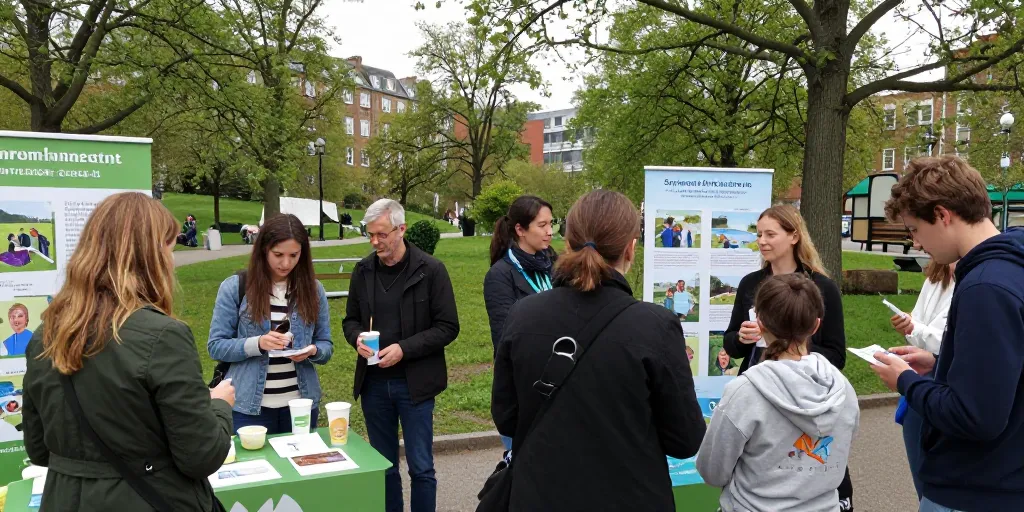
Organizing a responsible public event doesn’t mean sacrificing the fun for the sake of good intentions. We’ve all been to that meeting where someone timidly brings up the idea of reusable cups, only for the topic to get buried under a pile of logistical emergencies. The result: CSR considerations come up after the fact, when all that’s left are the decorations and regrets. At Allumee, we see exactly the opposite with our municipal drone shows, where environmental impact and public safety are factored in from the very start of the project—not tacked on as an afterthought. It’s this shift in approach that changes everything when organizing a public event, whether it brings together 300 or 30,000 people. Are you ready to organize an event?

CSR must be incorporated into the project before the initial organizational decisions are made
The typical approach is to choose the venue, date, and service provider before considering how to make the whole event sustainable. It’s the reverse order that works. ADEME regularly publishes case studies showing that an event planned in advance with environmental criteria in mind reduces its carbon footprint far more significantly than one where environmental considerations are added as an afterthought.
Set environmental and social goals appropriate for the event
A music festival doesn’t have the same tools at its disposal as a trade show or a large-scale outdoor public event. Setting realistic goals helps avoid the trap of accidental greenwashing—where an event promises carbon neutrality without having the means to achieve it.
Identify the positions where the main impacts are concentrated
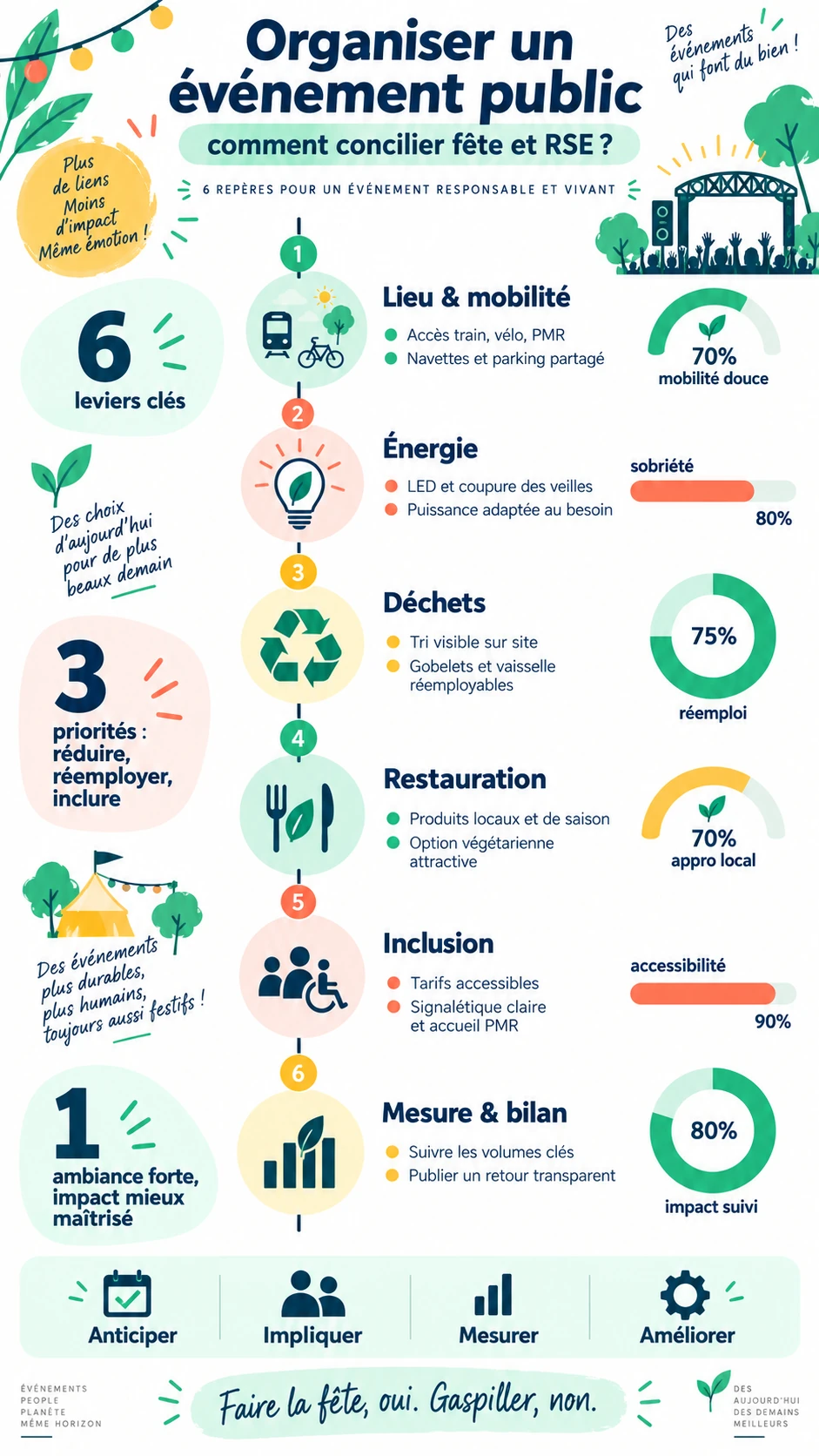
At most public events, three areas account for the bulk of the environmental footprint: audience movement, food service, and energy consumption on-site. Focusing efforts on these three pillars yields greater results than scattering symbolic, small-scale actions here and there.
The venue plays a major role in shaping the event’s impact
The choice of site determines almost everything else: accessibility, energy consumption, and the need for temporary facilities. We believe that a poor choice of location can never be fully made up for, even with the best intentions afterward.
Choose a site that is accessible and suitable for the expected capacity
A space that’s too large wastes energy heating or lighting empty space. A space that’s too small creates dangerous bottlenecks. The right size is the one that matches reality, not a fantasy of high foot traffic.
Make use of existing equipment rather than setting up more temporary facilities
Every temporary structure that is rented involves transportation, setup, and takedown. Reusing what is already on site—such as bleachers, restrooms, and permanent lighting—significantly reduces the event’s logistical footprint.
Public transportation is becoming a key factor in a responsible festival
We often say this internally at Allumee: the audience’s commute has a greater impact on the carbon footprint than any stage design. It’s counterintuitive, but figures from the Shift Project consistently confirm this for large gatherings.
Make it easier to get around by public transportation, bicycle, and on foot
Negotiating shuttle services or preferential rates with local transit systems is a game-changer. A secure bike parking area that’s clearly visible right at the site entrance naturally encourages people to choose this option.
Planning the final kilometers when the site is difficult to access
Many outdoor performances take place in areas with poor public transportation access. A shuttle bus between the train station and the venue often solves 80% of the transportation problem on its own.
Encourage participants to choose their mode of transportation without making them feel guilty
No one likes to feel judged for driving their car when there’s no alternative. The right approach is to make it easier, never to lecture.
The food and beverage industry can combine enjoyment with CSR commitments
Food waste at public events remains an all-too-often overlooked issue, even though solutions exist and do not cost any more.
Adjust portion sizes to reduce food waste
A forecast based on actual ticket sales—rather than optimistic estimates—prevents tons of food from being thrown away at the end of the evening.
Focus on local, seasonal products and plant-based alternatives
Short supply chains reduce transportation and support the local economy. Consistently offering a plant-based option also meets growing public demand.
Reducing single-use items without complicating the audience experience
Reusable, returnable cups are now in use at most major events in France. The logistics of collecting them have become much simpler in recent years.
- Reduced waste
- Positive public image
- Costs controlled over the long term
- Initial investment in equipment
- Collection logistics to be organized
Waste, energy, and set design must remain invisible to participants
Simplicity should never be obvious. The audience comes to enjoy the moment, not to witness a display of ecological virtue.
Design the sorting system so that it is intuitive even in a festive setting
Clearly labeled bins, placed along natural traffic routes, increase the rate of proper sorting without requiring any additional communication efforts.
Reuse furniture, signage, and decorative elements
A modular set, designed to be used for multiple productions, offsets its environmental and financial costs over time.
Design lighting and technical equipment based on actual needs
LED technologies drastically reduce power consumption compared to traditional equipment, a fact we see firsthand in our own light show systems.
A responsible public event must also be accessible and inclusive
CSR is not limited to the environment. Accessibility and inclusion are integral parts of a truly responsible event.
Planning for the Reception of People with Disabilities
Ramps, designated spaces, and appropriate signage: these elements should be planned from the very beginning of the site’s design, not at the last minute under pressure from a complaint.
Provide spaces and services tailored to different audiences
Family-friendly areas, quiet zones, easy access for strollers: thinking big automatically broadens the event’s reach.
Incorporate social considerations into the selection of service providers and partners
Working with employment integration organizations or sheltered workshops for certain logistics tasks reinforces the event’s social dimension.
Accessibility
Access ramps and accessible signage
Inclusion
Family-friendly spaces
Social integration
Committed service providers
Comfort
Designated quiet zones
How can we raise public awareness without turning the event into a lesson in corporate social responsibility?
This is probably the trickiest part of the whole exercise. Too much talking drowns out the message—we all know this from having experienced it as audience members.
Make responsible systems simple and easy to use
A well-designed recycling system can be understood in three seconds, without a long, drawn-out explanatory sign.
Making Certain Commitments Part of the Experience
A drone light show illustrates this concept well: the technological feat and the audience’s sense of wonder become the message themselves, without any additional commentary.
Focus on communicating concrete actions rather than making a string of promises
Stating a specific figure—such as the percentage of waste sorted during the previous event—is more convincing than a lengthy statement of commitments.
A socially responsible event is something you feel—it can't be explained.
Service providers must be involved in the event’s commitments
A single event planner can’t handle everything on their own. Vendors—from caterers to sound technicians—play a direct role in the overall experience.
Incorporate CSR criteria from the initial consultation and quotation stages
Asking service providers about their environmental commitments right from the request for proposals stage changes the responses received—and, consequently, practices on the ground.
Balancing proximity, cost, impact, and service quality
A local service provider isn’t always the cheapest option, but it often reduces the distance traveled and makes coordination easier on the day of the event.
Define measurable commitments rather than a purely declarative charter
A charter signed without monitoring metrics is worthless. We consistently prefer commitments that are quantifiable and verifiable after the fact.
Measuring the impact helps determine whether the event was actually responsible
Without measurement, it’s impossible to know whether the efforts paid off. The post-event review deserves just as much attention as the preparation itself.
Track a few indicators related to travel, waste, and consumption
Three to five well-chosen indicators are more than enough: recycling rate, the public’s primary mode of transportation, and total electricity consumption.
Also assess accessibility, satisfaction, and local impact
A simple satisfaction survey, sent out a few days after the event, often reveals areas for improvement that aren’t apparent at the time.
Use the review to improve the next edition
A review is only valuable if it is actually used to adjust the next edition. That is when the CSR approach truly becomes an ongoing process rather than a one-time effort.
- Continuous improvement of publications
- Strong communication strategy
- Building loyalty among an audience concerned with these issues
Organizing a responsible public event remains a balancing act
Organizing a responsible public event requires neither a miracle nor a financial sacrifice. It’s a series of consistent choices, made early in the project, that ultimately come together to form a credible whole in the eyes of the public. With each edition, you can fine-tune the balance between environmental goals, budgetary feasibility, and participant enjoyment. So, what’s the first CSR initiative you’ll try out at your next event?
Frequently Asked Questions About Organizing a Responsible Public Event
How can you make an event more eco-friendly?
By focusing primarily on attendee transportation, food service, and on-site energy consumption—the three areas that account for the bulk of an event’s carbon footprint.
What CSR criteria should be incorporated into event planning?
Location, mobility, food, waste management, accessibility, and service providers’ commitments form the foundation of the CSR criteria that must be incorporated from the design phase onward.
How can we reduce waste at a public event?
Intuitive sorting, reusable returnable cups, and the reuse of signage drastically reduce the amount of waste generated by each event.
How can we balance a festive event with energy efficiency?
LED lighting, the proper sizing of technical equipment, and the use of existing infrastructure enable energy efficiency that remains invisible to the public.
How can you measure the environmental impact of an event?
By tracking a limited number of measurable indicators, such as the recycling rate, the primary mode of transportation, and the site’s total electricity consumption.