

In a nutshell
Event-related competitive bidding covers dozens of types of services—and the approach varies drastically depending on whether the contract is public or private.
- Two types of users utilize this marketplace: service providers looking for contracts and clients issuing requests for proposals.
- On average, a proposal takes an agency one month to complete, with no guarantee of results.
- BOAMP, France: Public procurement markets and private platforms—sources of calls for bids do not operate under the same rules.
The event bidding process is undoubtedly one of the most misunderstood processes in the industry. People often imagine it as a procedure reserved for large Parisian agencies, brimming with client references and massive marketing budgets. The reality is more nuanced, more accessible in some areas, and frankly more demanding than people give it credit for. Whether you’re an event agency looking for new markets, a local government wanting to organize a festival or seminar, or an independent service provider wondering if any of this really applies to you, let’s sort this out together. Honestly, without legal jargon, and covering angles that the competition doesn’t address. Then you’ll be able to opt for a drone show for local governments!

What is an event project as defined in public procurement?
An event project featuring a drone show, as defined by public procurement law, encompasses any purchase of services related to the organization, production, or staging of an event by an entity subject to public procurement law. Specifically: corporate seminars, cultural festivals, downtown events, concerts, fairs, conventions, exhibitions, gala dinners, or sound-and-light shows. Each of these event types corresponds to a specific CPV code (Common Procurement Vocabulary), and therefore to different competitive bidding requirements depending on the estimated contract value.
Public procurement vs. private procurement: two radically different approaches to competitive bidding
Public procurement follows the Public Procurement Code, with standardized procedures, statutory deadlines, and notices published in the BOAMP or on an electronic platform. Private contracts are governed by rules specific to each client—whether a company, association, or foundation. The deadline, application requirements, and bid evaluation criteria are set at the client’s discretion. For a service provider, responding to a private request for proposals requires less formalities but more interpersonal skills. We believe that these two markets warrant distinct strategies, and that many event agencies make the mistake of applying the same response template to both.
What are the three types of competitive bidding?
The Public Procurement Code distinguishes between three main types of procedures. The simplified procedure (MAPA) applies for contracts below the European thresholds: it gives the public procurer considerable flexibility regarding the terms of the competitive bidding process. The formal open procedure requires the publication of a public call for competition (AAPC) and sets minimum response deadlines. The restricted formal procedure adds a candidate preselection phase before the request for proposals (RFP) is sent to companies. In the events industry, the vast majority of contracts fall under the simplified procedure—which makes the sector much more accessible than one might imagine.
The True Hidden Cost of Event RFP Processes for Service Providers
The Orléans-based agency Atipic has identified an important point: developing a substantive response to a large-scale event RFP requires, on average, four weeks of intensive work. Set design, logistics, budgeting, drafting the technical proposal, providing cost estimates—all of this with no guarantee of being selected or compensated. In most cases, the deadline passes, the award notice is published… and the losing bidder receives nothing. No compensation for real, documented, high-quality work. This is the sector’s central paradox, and it explains a great deal.
Why Do Most Event Agencies Avoid Public RFP Processes—and When Are They Wrong?
A LinkedIn post by freelancer Régis Clinquart put it bluntly: most event communications agencies don’t like RFP processes. It’s easy to see why—the administrative burden is real, deadlines are often tight, and the conversion rate is disappointing. But this reluctance creates an opportunity. Fewer serious competitors in a bid means, automatically, a better chance of being selected. We believe that agencies that know how to streamline their response process—with proposal templates, reference libraries, and rapid cost-estimation tools—turn RFPs into a lever for steady growth, whereas others see them as a burden.
Can small businesses really win public contracts for events?
The answer is yes—provided you target the right contracts and follow the right procedures. A municipality that issues a call for bids for a summer event or an end-of-year show often publishes a MAPA with thresholds accessible to small and medium-sized enterprises and independent contractors. GL events, the global leader in event management with over 1,600 million euros in revenue, does not bid on these contracts. The field is wide open. What eliminates small organizations isn’t their size, but the lack of up-to-date administrative documentation: tax and social security certificates, a Kbis extract, and recent references. These documents must be prepared in advance, not the day before the deadline.
The 5 selection criteria that clients really prioritize
Technical Rating vs. Financial Rating: Understanding Actual Weighting Matrices
In public event procurement, the technical score typically accounts for 60% of the final score, while the financial score accounts for 40%. Some buyers even raise the weight of the technical score to 70%. Why? Because a failed event costs far more in terms of reputation than a service that is only slightly above the minimum price. The five most frequently weighted criteria are: understanding of the client’s needs (often 25%), the quality of the proposed event design (20%), industry-specific references (15%), the human resources deployed (10%), and adherence to deadlines (10%). Price comes last in the actual decision-making hierarchy—even if this isn’t always acknowledged.
| Criterion | Typical weighting |
|---|---|
| Understanding the Need | 25% |
| Quality of the set design | 20% |
| Industry References | 15% |
| Human Resources | 10% |
| Price | 40% |
What the award notices published in the BOAMP reveal about prevailing prices
The Official Bulletin of Public Procurement Notices (BOAMP) publishes award notices after each contract is awarded. These notices indicate the amount awarded, the number of bids received, and, in some cases, the range of prices submitted. It’s a goldmine for setting your rates: an event planner who regularly reviews award notices in their industry segment knows what local governments actually pay for a Christmas event, a 200-person seminar, or a sound-and-light show. Fewer than 10% of agencies monitor these award notices—and this is precisely what sets repeat clients apart from one-time bidders.
What are the legal obligations of an event organizer?
Any organizer of an event open to the public is subject to specific obligations. The decree of June 25, 1980, establishes safety regulations for establishments open to the public (ERP). For outdoor events with more than 1,500 attendees, a security service is mandatory. Organizers are required to carry civil liability insurance starting with the very first attendee. In public procurement, these obligations become eligibility criteria: a bidder unable to provide proof of insurance and security clearances is automatically disqualified upon opening of the bids.
Find event tenders without getting lost on the platforms
BOAMP, France Marchés, AAPC: The Practical Differences Between These Sources
The BOAMP centralizes official notices for French public procurement contracts above the European thresholds. France Marchés (MPF) aggregates contracts of all sizes, with filters by sector, region, and publication date. Regional e-procurement platforms (buyer profiles) directly publish downloadable request for proposals (RFPs). The key difference: the BOAMP mandates a regulatory publication date and minimum timeframes between publication and the submission deadline. France Marchés and private aggregators such as j360 or e-marchespublics also list private contracts, which the BOAMP does not. For comprehensive monitoring, both sources are essential.
Event RFP by segment: sports, festivals, seminars, entertainment
RFP processes fall into four major segments, each with very different approaches. RFPs for sporting events often involve specific requirements for private security and crowd management. Festival RFPs involve multiple simultaneous contracts—set design, sound systems, catering, and security. Seminar tenders are the most accessible for catering providers and mid-sized agencies. Event entertainment tenders are often awarded to small local organizations through a simple MAPA (Administrative Procurement Agreement). Filtering by segment early in the monitoring phase saves considerable time and automatically improves the relevance of the proposals reviewed.
Automating Market Monitoring with AI: The Competitive Advantage That Established Agencies Are Already Capitalizing On
The Comeeti live stream in July 2024 demonstrated this over the course of more than an hour: artificial intelligence is transforming how companies respond to event-related requests for proposals. Tools capable of automatically analyzing a request for proposals (RFP), identifying weighting criteria, and drafting the outline for the technical proposal already exist and are being used by established agencies. For smaller organizations, the first step is simpler: set up targeted email alerts on platforms (France Marchés, BOAMP, and their regional buyer profile) based on keywords, CPV codes, and geographic area. Half an hour of setup replaces one hour of daily manual monitoring.
Segment
Target Service Provider Profile
Most Common Procedure
Level of Complexity
Athletic
Security, Logistics, Transportation
Formalized or MAPA
High
Festival
Global agencies, multiple lots
Formalized
High
Seminar
Catering, AV, lodging
MAPA
Medium
Entertainment
Small local organizations
Simple MAPA
Accessible
How to Write a Technical Proposal That Stands Out in an Event RFP
Structuring the Request for Proposals from the Service Provider’s Perspective: What a Public Procuring Entity Reads First
A public procurer reviews a bid submission in this specific order: verifying administrative completeness, reading the executive summary of the technical proposal, and analyzing the financial proposal. The first three pages of the proposal are crucial. They must restate the client’s needs in the client’s own words, outline the unique value proposition, and set out the proposal’s structure. A proposal that begins with two pages introducing the agency is mentally dismissed before page 3. This reflex is universal in public procurement departments—and yet, the majority of proposals received begin exactly that way.
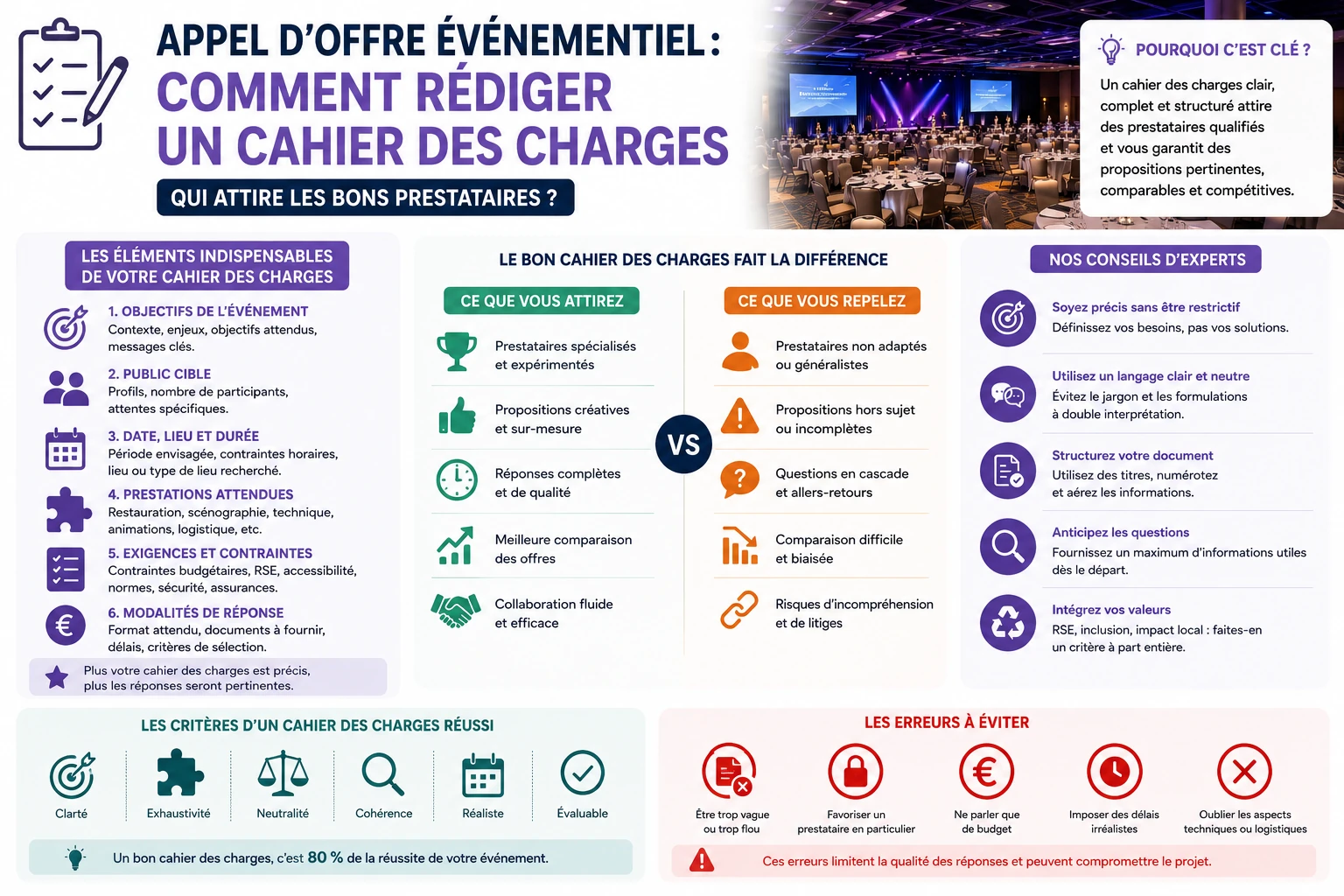
Set design, logistics, private security: how to highlight each category in your thesis
In multi-lot bids, each lot is evaluated using a separate scoring grid. The set design lot emphasizes measurable creativity: the number of proposed configurations, equipment used, and comparable references in terms of floor space and capacity. The logistics and transportation lot prioritizes responsiveness and setup/teardown times. The private security lot requires specific certifications and a staff-to-audience ratio that complies with prefectural recommendations. A service provider such as Allumee, which specializes in light drone shows, will primarily bid on the set design and artistic production lots—and must document its DGAC flight authorizations as well as its perimeter security protocols for each show format.
A bid proposal either wins the contract within the first three pages of the technical proposal—or it loses it.
Formal errors that result in a case being dismissed before it is even reviewed on its merits
There are three errors that consistently crop up in post-award analyses. First error: the bid is submitted after the specified deadline—even a one-minute delay results in disqualification with no possibility of appeal. Second mistake: The electronic signature is missing or placed on the wrong document—some buyers require the signature on the DC1, others on the BPU, and still others on both. Third mistake: the bid responds to the wrong variant or omits a mandatory lot specified in the request for proposals. These procedural errors cannot be corrected once the bids have been opened. A systematic two-step check—an administrative checklist followed by a review of the request for proposals—eliminates them 100%.
- Technical proposal structured according to the RC criteria
- Quantified references with surface areas and capacities
- Executive summary on page 1
- Opening agency presentation
- No proposed alternatives
- Missing electronic signature
The Event RFP as a Strategic Playing Field
The event tender market remains underutilized by most service providers in the sector. Too many agencies shy away from it without having truly explored the available segments. Too many clients draft generic requests for proposals that fail to attract the best candidates. The good news is that both problems can be solved with a systematic approach, not with additional resources. Organizing your market research, structuring your proposals, and reviewing award notices—these are foundational tasks that pay off over time.
FAQ: Event RFP — The Questions Everyone Asks
Does the events industry pay well?
The events industry exhibits very significant pay disparities depending on employment status, specialty, and the size of the organization. An events production manager at an SME starts at between 28,000 and 35,000 euros gross annually. A senior artistic director at an established agency earns between 60,000 and 80,000 euros. Specialized independent service providers—sound, lighting, drone shows—charge between 1,500 and 15,000 euros per service, depending on the format. The MICE (Meetings, Incentives, Conferences, Exhibitions) sector has the highest profit margins, particularly for international corporate events.
What is an event project?
An event project refers to any planned initiative aimed at bringing an audience together for a shared experience: a performance, conference, trade show, festival, corporate seminar, gala, or cultural event. It is characterized by a deadline, a defined budget, a specific production design, and multiple stakeholders (client, service providers, audience, authorities). In public procurement, it corresponds to specific CPV codes that determine the requirements for competitive bidding.
What are the legal obligations of an event organizer?
An event organizer is required to purchase organizer liability insurance, to register the event with the prefecture if attendance exceeds certain thresholds, to comply with the public access building (ERP) standards established by the decree of June 25, 1980, and to provide professional security personnel for gatherings of more than 1,500 people. For events involving fireworks or drones, specific authorizations from the DGAC and the prefecture are required in addition to these basic obligations.