

What you need to know about the art of announcing a corporate event
- Internal communication is a tailor-made process., between precision strategy and unforeseen events, and each member puts their own stamp on it, however whimsical.
- Diffusion doesn't rely on any magic formula., She juggles emails, intranet, posters or social networks, depending on the collective mood… and the morning coffee.
- The most important thing is the feedback, sometimes scattered., because true success is measured in the ability to adapt, bounce back, invent, page after page.
Imagine a peaceful morning. You open your email, and there's nothing there, or perhaps this webpage, like a tiny beacon in the background of your browser, signaling the birth of a new collective adventure. Sometimes it's a vague buzz on social media, a seemingly innocuous post, and something starts to stir in the corporate atmosphere. You immediately feel that mixture of diffuse excitement and questions. A single, luminous image, almost fleeting, awakens your attention. You won't be disappointed by the drone show.
So there exists this silent ballet, where publication demands diabolical precision, where website management borders on human tenderness, where technical virtuosity and collective warmth play the same score. You smile at the diversity of internal reactions, as some applaud, others doubt, and a few, resolutely skeptical, are almost worried. A form, that tool sometimes forgotten in the folds of the intranet, suddenly has its moment of glory, because visibility now depends on its relevance. You see, it all has the air of choreography; the launchpad for communication opens, a clear stage for the first waltz. You are looking for a professional event entertainment ?
Understanding the challenges of internal communication when announcing a company event
Announcing an event has never been solely about image, far from it. Sometimes you wonder if the effect on the ground matters more than the intention, yet it all begins with that internal message. You target, you calibrate, and, relentlessly, you nurture the collective bond. The strategy is bearing fruit, but requires finesse and a certain tenacity. You try to draw precise outlines with each action, You hope that cohesion will be long-lasting. Thus, internal dynamism does not germinate by chance; you sow, you cultivate, and all of this can be seen in the team's ability to react and co-create the experience.
The strategic and operational objectives of internal communication
You approach communication within the company as the cornerstone of collective momentum. It's never just a matter of scheduling, displaying dates, or even choosing a page. You lead, whenever possible, concrete projects to support every small change within your teams. You make it the basis for a coherent sharing and you constantly strive to maintain this momentum of support which we sometimes feel wavering.
However, in fact, you realize that every publication becomes, over time, a lever of impact, that the cycle is oriented towards the membership of each service, of an association, of a municipality. The content always finds its target audience within the collective And you shape it, piece by piece, to weave together belonging and pride.
Key players in corporate advertising
You can easily identify the different profiles involved in disseminating information about the event. Senior management, yes, lays the foundation, charts the course, and establishes its legitimacy with the initial announcement. You, sometimes, become that intermediary, responsible for smoothing communication, facilitating email sharing, and adapting the tone or approach as needed, depending on the department.
Communication, even technical communication, remains mobile and evolving, never static.. You contribute, page by page, email by email, to make people smile or spark the momentum needed for mobilization. The dedicated team checks, edits, adjusts, paces, and follows up to ensure everything is clear and easy to understand. Suddenly, you realize that the final publication, once seemingly insignificant, now occupies a central position, poised between visibility and validation. Indeed, every player recognizes themselves in this dynamic, sometimes chaotic, yet profoundly human, process that shapes the success of the announcement.
The structured preparation of announcing a company event
Every event, however trivial it may seem, requires preparation that borders on exhaustive. Yet, you know very well that nothing ever goes as planned.
The preliminary steps and communication planning
You begin, sometimes without much conviction, with a thorough analysis of your target audience: each department, each partner, all those people emerging from the company's social mosaic. You strive to establish the context, to tailor the content and the page to the needs of the moment.
The description, the time slot, the contact details – everything is decided with precision.. However, the medium, the distribution category, the platform – that's where everything changes. You might one morning encounter a stubborn form, a description field that's too short, a capricious date, and that's when real planning reveals its subtleties, a world away from theory. You feel that a forgotten detail can sometimes tip the balance., and you reopen the established order to reorganize everything.
The construction of the internal communication plan
In your world, the plan is as essential as it is daunting; it demands rigor, yet leaves room for restrained creativity. You craft, line by line, the message to be conveyed, refining it, simplifying it, depending on the audience and the prevailing mood. The image, sometimes secondary, ultimately becomes the very heart of the broadcast, like the promise of a tangible event.
Including the human element in this system means rejecting cold, mechanical approaches.. You open the form, you plan the link, you respond to an unusual request., Then you adjust in real time. The collective dimension is built through these back-and-forth exchanges; you shape the plan carefully, because the diversity of those receiving it precludes ready-made thinking. Thus, osmosis, however imperfect, always arises from a shared will; you can't change it, that's just how it is.
The deployment of communication during the announcement of the event
Faced with the abundance of media options, you wonder which channel will best capture the moment – a truly difficult choice. A routine for some, a complex equation for others.
The best distribution channels for a successful announcement
You hesitate, one hand on the keyboard, the other on the mouse, between the website, the intranet, email, or that social network where everyone's escaping, where the rules change at the last minute. Email, why not? It's enjoying a resurgence, even though we doubted it; its simplicity is appealing, sometimes too much so. As for web pages, you believe in them because they grab everyone's attention at once. Publishing is never an innocent act. You check the format, you tolerate a large file, sometimes you fine-tune the visuals.
Some regions still favor physical displays, but you sense that virality often stems from the discreet click on the shared feed. The distribution channel, geared towards a particular category or another, shapes perception; there's no one-size-fits-all solution. A successful event, on the contrary, occurs when the message resonates with the audience, however unexpected it may be.
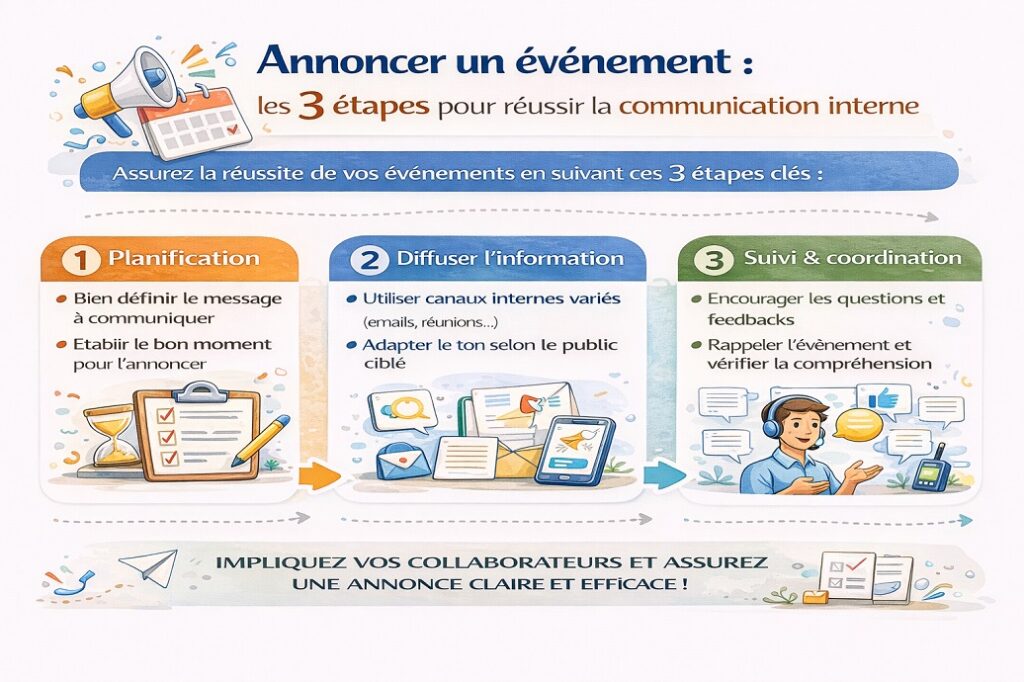
Announcing an event: steps to successful internal communication
What you need to know about the art of announcing a corporate event
Internal communication, a delicate art balancing precise strategy with unforeseen events, is a skill that requires careful attention. Each member brings their own unique touch, sometimes quirky, but always essential. Information is disseminated through various channels: emails, intranet, posters, or social media, depending on the team's mood and energy levels. True success lies in the ability to adapt, react, and adjust every detail to maintain team engagement.
Imagine the excitement of an internal event, launched by a single captivating visual, like a visual teaser for a drone show. This type of synchronized, high-tech aerial show instantly captures attention and reignites enthusiasm among teams. Allumee understands that originality and visual impact are powerful tools for uniting and engaging employees. Such an event becomes more than just a show; it's a way to bring the company to life through a unique and memorable experience.
Understanding the challenges of internal communication when announcing a company event
Announcing a company event is much more than a mere formality. It must nurture collective identity, create a sense of cohesion, and strengthen everyone's involvement. With a well-calibrated approach, such as that of’Allumee, Internal communication becomes the driving force that unites people around a common project. A show like a drone show becomes a point of convergence, a moment where the brand reinvents itself, and where each employee becomes a stakeholder in the event's success.
Frequently Asked Questions
How do I announce an event?
There was that time the team missed a launch, all because we'd forgotten the announcement. Since then, the goal has been simple: grab attention. No fluff, just a clear message, with obvious benefits for every employee. A little trick: a striking image, and voilà, the team spirit is ready to spring into action.
How to communicate about an event?
A project is already quite a challenge, so for an event, the methods are just as varied. A savvy manager combines social media and word-of-mouth… Sometimes a poster in the break room works better than three meetings. The moral of the story: there's no magic formula, but an action plan that truly aligns with the company culture is essential.
How do you introduce an event?
Imagine arriving at a meeting, and no one understands the topic or the objective… Awkward. The key to introducing an event is to put yourself in the shoes of the invited colleague. Provide some clear information: date, location, and the day's mission. The team feels expected and invested in the collective project.
How can I advertise an event for free?
Honestly, who hasn't tried to get an event announcement out on the company intranet or via professional networks, all without a budget? The trick: use every free channel available. The best opportunities are often found in the open-plan office or in a simple group email. The result: maximum visibility, minimal budget.