In a nutshell
Three documents, one area of expertise, zero compromises on DGAC compliance.
- A reputable drone operator submits its DGAC declaration, aviation liability insurance, and flight plans without being asked to do so.
- A professional drone operator’s sector-specific expertise directly impacts the quality of the final deliverables.
- Low-cost estimates often overlook actual expenses: flight permits, post-production, and contingency plans.
Choosing a drone service provider is one of those decisions where it’s easy to underestimate the difference between a qualified professional and a well-equipped amateur. The French market is full of operators who post stunning 4K videos on Instagram, but that’s not the point. It’s about regulatory compliance, genuine expertise, and the ability to manage a mission from start to finish without you having to clean up after any oversights. We’ll lay everything out clearly, sector by sector, document by document. You can then turn to Allumee, a drone entertainment company.

Drone service provider, drone operator, drone pilot: three terms, three very different realities
What exactly does the status of a remote-controlled aircraft operator entail in France?
In France, regulations require a clear distinction even for a drone show at a wedding. A remote-controlled aircraft operator—referred to as an OAT under the regulatory framework of the Directorate General of Civil Aviation (DGAC)—is a registered entity that assumes full responsibility for commercial flights. The remote pilot, on the other hand, is the individual at the controls who holds a training certificate issued in accordance with the categories defined by EASA. The “professional drone operator,” a more informal term, often encompasses both roles in small organizations. These three roles do not share the same legal obligations or the same levels of responsibility.
Why Confusing These Roles Can Ruin a Mission Before It Even Takes Off
A freelance drone pilot without an OAT certification is not authorized to perform commercial missions, regardless of the quality of their equipment. Hiring such a pilot exposes the client to shared liability in the event of an incident. The Air Transport Police regularly inspects the conditions of professional flights. An unregistered service provider caught on site jeopardizes the mission and poses a legal risk to your company. The desire to save a few hundred euros at this stage does not justify the level of risk involved.
The documents a legitimate drone service provider will provide you with without you having to ask for them
DGAC Declaration, Aviation Liability Insurance, and Flight Scenarios: What Each Document Specifically Covers
The DGAC declaration establishes the legal status of the drone operator within the AlphaTango information system. Aviation liability insurance specifically covers damage caused to third parties during flights; this coverage is distinct from standard professional liability insurance. Regulatory flight scenarios, derived from the European EASA framework, define permissible flight zones, authorized altitudes, and acceptable weather conditions. Each document follows a specific procedure and ensures a measurable level of safety for the mission.
What it reveals when a service provider hesitates to provide these documents voluntarily
A professional drone operator who hesitated to produce his documents during an initial business meeting almost always revealed one of two realities: either his information was out of date, or he was operating without adequate coverage. Hesitation is never a trivial matter in this industry. A serious drone operator presents these documents instinctively, just as a tradesperson presents their ten-year warranty certificate. Choosing a drone service provider also means picking up on these kinds of signals even before discussing price.
What the Portfolio Doesn’t Show: How to Evaluate a Professional Drone Operator’s Work Like an Expert
Image quality, flight conditions, and the complexity of the areas flown over: the key indicators to look for
A portfolio of aerial footage shot under bright sunshine, with no wind, and over open countryside doesn’t prove much. The real work worth analyzing is that shot under challenging conditions: dense urban areas, night flights, areas near an airfield, and restricted altitudes. The quality of 4K or 6K footage matters, but how the operator handles complex flight conditions reveals their true skill level. Also pay attention to stabilization, the fluidity of camera movements, and the consistency of the editing if finished videos are presented.
Specific questions to ask about deliverables—format, resolution, deadlines—before requesting a quote
Ask about the raw delivery format and the final format, the target resolution, post-production timelines, and whether color grading is included. A drone service provider that delivers raw ProRes footage without post-processing may sometimes bill you for an incomplete job. Some quotes exclude post-production stabilization or final editing. These elements directly impact your communication and your final product. A well-structured quote details every step, from takeoff to file delivery.
Delivery Format
Specify in the quote: raw or finalized
Resolution
4K minimum for professional use
Timelines
Include post-production in the schedule
Color Grading
Often not included in the base package
Industry specialization: the factor that the Top 10 barely touches upon—and that makes all the difference in the final result
Why isn’t an aerial event photography service provider interchangeable with a drone operator in the construction industry or photogrammetry?
A drone operator specializing in photogrammetry works with 3D modeling software, is proficient in automated flight plans, and produces data that can be used in urban planning, archaeology, or construction site monitoring. A service provider specializing in aerial event photography manages crowds, tight schedules, and dynamic scenes. These two activities require radically different skills, equipment, and approaches. Confusing them inevitably results in a final product that falls short of expectations.
How can you identify a drone operator who is truly specialized in your field—and not just a jack-of-all-trades on paper?
A truly specialized drone operator cites specific industry references, technical challenges they’ve already overcome in your field, and deliverables tailored to your needs. The versatility touted on a website often masks only superficial experience in each sector. For light drone shows like those by Allumee, which involve up to 500 drones flying in synchronized formation, specialization in fleet choreography is non-negotiable. It’s not the same line of work as a thermographic roof inspection.
Understanding a Drone Service Quote to Avoid Comparing Incomparable Offers
Rates based on projects, half-days, or deliverables: what each model means for your actual budget
A per-assignment rate theoretically covers everything, from travel to delivery. A half-day rate bills for time spent on site, not for the result. A per-deliverable rate ties payment to the actual production of specified files. Each pricing model involves a different approach to risk management. For a short, well-defined project, the per-project rate protects your budget. For a complex audiovisual production involving multiple aerial shots, the per-deliverable rate ensures the expected quality.
Items often omitted from a low-cost estimate that end up driving up the final bill
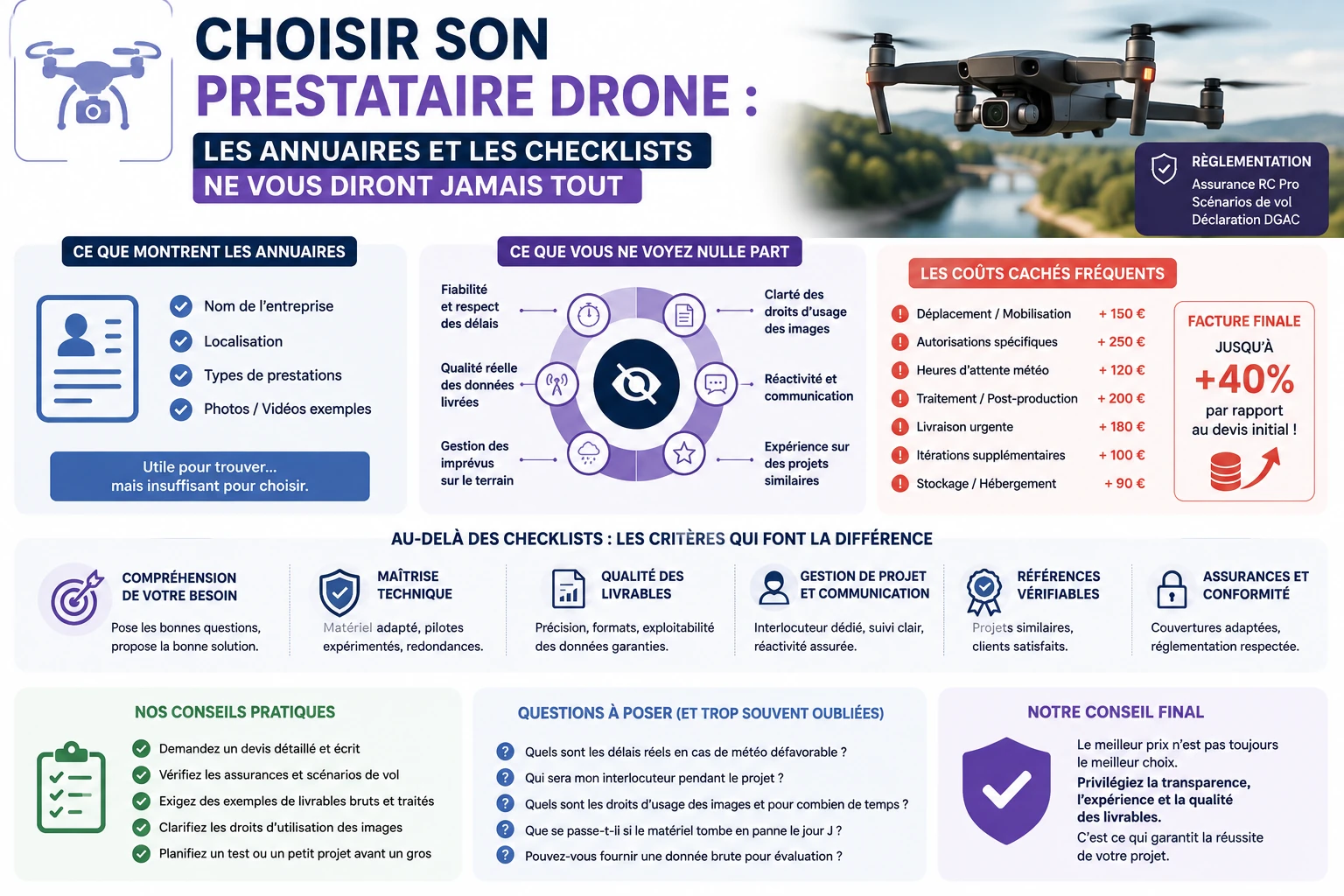
Low-cost quotes often omit the following: the process of obtaining authorization to fly in restricted areas, travel expenses beyond a certain radius, backup equipment in case of a breakdown, post-production, and sometimes even aviation liability insurance. These items often resurface during the assignment in the form of additional charges. A comprehensive quote lists them explicitly. The absence of these items in a commercial document is a red flag, not a price advantage.
- Detailed, transparent quote
- Every item is verifiable
- No surprises during the project
- Vague, less clear quote
- Frequent hidden charges
- Impossible to compare quotes
What Happens on D-Day: Operational Preparation—The Blind Spot in All Recruitment Articles
Flight authorization management, area analysis, and contingency plan: what a reputable service provider does before arriving on site
A professional drone service provider analyzes the mission area in advance: reviewing aeronautical charts, identifying restricted areas, checking weather conditions 48 days and 24 days prior to the mission, and filing NOTAMs if necessary. They also develop a contingency plan in case of winds exceeding regulatory thresholds or equipment failure. These steps take time and incur costs. They never appear in a low-cost quote because they simply aren’t carried out.
Your responsibility as a client placing an order—a point that few service providers address upfront
The client shares responsibility for drone services. If you impose non-compliant flight conditions—such as flying in a restricted area, at excessive altitudes, or over people without prefectural authorization—you may be held liable. A reputable service provider will inform you of these restrictions before you sign the contract. An operator who unquestioningly accepts conditions that are impossible under current regulations is not demonstrating flexibility; rather, they are proving that they do not understand the applicable regulations.
Choosing a drone service provider also means agreeing to be briefed on your own obligations before the first flight.
Choosing a drone service provider: The decision is made before the first takeoff
The criteria that distinguish a reliable drone operator from a service provider that falls short are always evident before the mission begins. Regulatory documents provided proactively, verifiable industry specialization, and a comprehensive quote with no gray areas. For projects with a strong visual impact, such as drone light shows, Allumee’s operational rigor proves that artistic excellence and regulatory compliance are not mutually exclusive. They reinforce one another.
FAQ: Your Final Questions Before Contacting a Drone Service Provider
What is the average price of a drone service?
A basic aerial photography service starts at around 300 to 500 euros for a half-day. A photogrammetry or technical inspection project costs between 800 and 2,500 euros, depending on the complexity of the area and the expected deliverables. A drone light show featuring 100 synchronized drones starts at several thousand euros. These price ranges do not include long-distance travel or advanced post-production.
Who is a drone service provider?
A drone service provider is a company or professional registered with the DGAC as a remote-controlled aircraft operator. It carries out commercial missions using drones, such as aerial photography, inspections, mapping, photogrammetry, thermography, and drone shows. Its activities are governed by EASA regulations and the French Civil Aviation Code.
What is the salary of a drone operator?
A salaried drone pilot in France earns between 25,000 and 45,000 euros gross annually, depending on their level of experience and industry. A freelance drone operator specializing in audiovisual production or photogrammetry can earn more than these amounts on high-value-added assignments. These figures vary significantly depending on the operator’s specialization and the volume of assignments completed.
What is the best drone company?
There is no one-size-fits-all answer. The best company for your project is one whose industry specialization exactly matches your needs, whose regulatory documentation is up to date, and whose track record demonstrates expertise in conditions comparable to yours. For public performances and custom events, Allumee is among the leading French companies specializing in light drone shows.