
In a nutshell
A memorable product launch is based on a real-life experience, not just an advertisement.
- The reveal turns the discovery into a memorable highlight
- Immersion transforms guests into users
- Professional photo and video coverage extends the event over time
A successful product launch first triggers a physical reaction in those who experience it. We all remember that evening when a client told us, “I got goosebumps when I saw that.” That’s exactly the goal behind every event brief: not to inform, but to evoke emotion. At Allumee, we design every event drone show as a moment of emotional transformation—the moment when the audience shifts from curiosity to wonder in a matter of seconds. This approach applies to any launch format, from a low-key showroom event to a major media spectacle. You need to organize a unique grand opening!
A product launch must first elicit a reaction
Before choosing a format, you need to ask yourself one simple question: What do I want people to feel when they leave? The answer determines everything else, from the budget to the set design.
Brand awareness, trial, and conversion do not require the same activation strategies
A brand awareness goal calls for a visible, spectacular, and shareable campaign. A product trial goal, on the other hand, requires time, direct contact, and hands-on experience with the product. Conversion, meanwhile, often takes place after the event, through an exclusive offer or early access. Confusing these three approaches is the most common mistake made by brands organizing their first major launch.
The target audience determines the format and the expected level of experience
A professional audience expects evidence and rigor. A general audience expects emotion and connection. We’ve seen tech brands host a glamorous cocktail party for engineers who came to test a product: the disconnect is immediately apparent in the feedback.
The reveal turns the product discovery experience into a highlight
The moment of revelation is the beating heart of any product launch. That’s when memorability comes into play—the kind that transforms a simple event into a memory people are still talking about six months later.
The set design and storytelling set the stage for the moment of revelation
A well-executed stage design builds tension before releasing it. Lighting, sound, calculated silence: every detail sets the stage for the moment when the product appears. Storytelling gives meaning to this moment; it explains why the product exists and for whom.
The live demonstration immediately brings that promise to life
Showing is always better than describing. A live demonstration eliminates doubt, proves the promise in real time, and provides material for content that people will naturally want to share.
Immersive experiences put the product at the center of the event
We often tell clients who come to us for advice: a product you look at from a distance is less memorable than one you’ve touched. Immersion changes the very nature of memory formation.
The product test transforms guests from spectators into users
As soon as a guest interacts with the product, they become an active participant in their own discovery. This shift changes everything: they no longer talk about what they saw; they talk about what they did.
The interactive installations bring the brand’s world and positioning to life
A well-designed installation translates into a physical experience what the brand has been trying to convey for months in its campaigns. It’s often more effective than a long speech.
The pop-up store extends the experience beyond a single evening
Unlike a one-time event, a pop-up store spreads out the product discovery experience over several days or weeks, increasing the number of touchpoints with different audiences.
The media, influencers, and communities help amplify a product launch
A product launch that remains confined to the room where it takes place has failed to fulfill part of its mission. The buzz begins even before the event takes place.
A preview offers exclusive access to key decision-makers
Inviting the press and a few designers in advance creates a sense of exclusivity that then translates into editorial coverage. We’ve found that these preview events often generate more buzz than the actual launch day itself.
Collaborations with designers offer multiple perspectives on the product
Each creator tells the product’s story from their own perspective, to their own community, in their own words. This diversity of narratives reaches audiences that the brand could never have reached on its own.
Community engagement initiatives encourage initial referrals
Giving a small community a voice before the general public does helps generate the first reviews—which are often the most sincere and the ones people refer to most later on.
Social media campaigns bring the launch to life beyond the venue
The physical event is only part of the story. What happens on social media in the hours that follow matters just as much—and sometimes even more.
Participatory platforms generate content that is naturally shareable
A unique photo booth, a light-up wall, and an installation designed for photos: these elements turn every guest into a spontaneous brand ambassador.
Photo and video coverage turns the event into a treasure trove of content
A good video recording provides months’ worth of content for social media, advertising campaigns, and marketing materials. We’ve seen brands recoup their entire event budget just from the footage shot that evening.
Teasers, live coverage, and behind-the-scenes footage keep viewers engaged before and after the big day
Well-timed teasers build anticipation. A live broadcast captures the moment. Behind-the-scenes glimpses shared after the event keep the conversation going. These three stages form a complete attention cycle.
A product launch doesn't end when the lights go out; it continues as long as the images keep circulating.
The right format depends as much on the product as it does on the brand
There is no one-size-fits-all approach. What works for a technological innovation often fails for a lifestyle product—and vice versa.
A technological innovation is best demonstrated and experienced firsthand
The public expects tangible evidence. An innovation that remains behind glass loses much of its persuasive power.
A lifestyle product lends itself more to immersion and styling
Here, emotion takes precedence over technical prowess. The staging creates a world in which the product fits in naturally.
A B2B launch emphasizes evidence, dialogue, and targeted demonstrations
A professional audience expects statistics, use cases, and time to ask specific questions. Emotion matters, but it comes after demonstrating value.
- Immediate and high visibility
- Content that can be reused for months
- Greater recall than a traditional campaign
- Often a higher budget
- Complex logistics
- Dependence on conditions on the day of the event
A successful product launch continues beyond the activation phase
The evening is coming to an end, but the work continues. In fact, that’s often when the real return on investment is determined.
Content and public statements maintain visibility over the long term
Photos, interviews, and guest feedback fuel a communications campaign that continues for several weeks after the event.
Guest feedback informs our communications and product development
A guest who tests a product live often provides more honest feedback than a traditional consumer panel. These comments sometimes lead to real product improvements.
KPIs link the customer experience to marketing and sales goals
Press coverage rates, volume of social media mentions, number of qualified leads: these metrics provide an objective way to measure what a mere impression of success alone cannot prove.
- Long-lasting brand recall
- Content that can be used over several months
- Product feedback that can be put to immediate use
Product Launch: What Really Makes the Difference
A memorable product launch is never just about a venue, catering, and a speech. It’s built around a highlight moment, a lived experience, and strategic amplification planned from the very beginning. We believe that brands that invest in emotion—rather than just logistics—achieve results that extend far beyond the event itself. It is this conviction that guides every drone show we design.
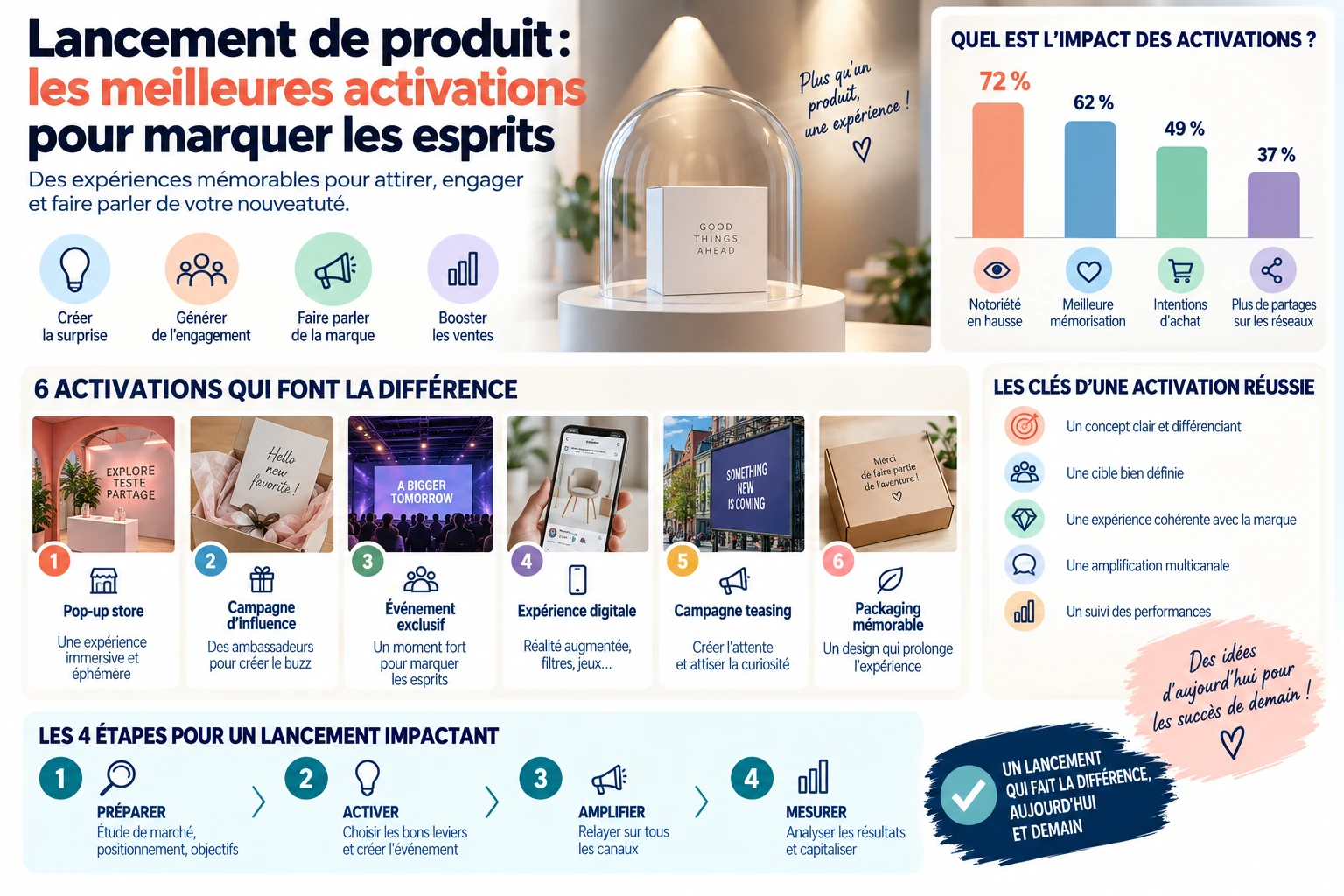
Frequently Asked Questions About Launch Activations
What kind of entertainment should you plan for a product launch?
The choice depends on the main objective: a technical demonstration to prove a point, an immersive installation to make an impression, or a visual spectacle to create a shared memory.
How can you generate buzz around a new product?
Buzz arises from a moment that’s impactful enough to be filmed and shared spontaneously, combined with carefully orchestrated teasers in the days leading up to the event.
What kind of event should you organize to launch a new product?
It all depends on the target audience: a press event for media coverage, an immersive experience for the general public, or a targeted demonstration for a B2B audience.
How do you measure the success of a product launch?
Success is measured by the amount of press coverage received, the volume of content generated on social media, and the leads or sales directly attributable to the event.