
Safety distances
What safety distance should be maintained for a drone show?
To determine the appropriate safety distance for our drone shows, please refer to our Concept of Operations, which has been approved by the DSAC and includes guidelines on the safety distances that must be observed.
It is essential to establish a sufficiently large safety zone to accommodate any drones that may crash. Since drones are flying objects, in the event of a technical failure, they may land or crash in a secure area outside the public viewing area.
To ensure that drones do not fly outside this safety zone, we have observers stationed around the flight zone. These observers constantly monitor the area to make sure no drone strays from the formation.
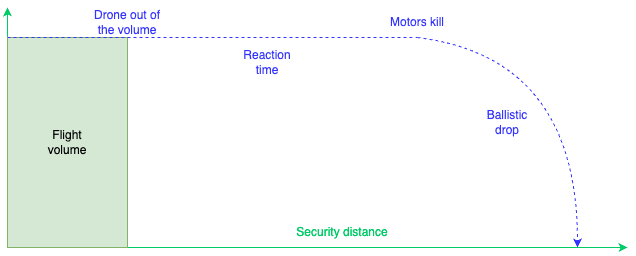
If a drone gets too close to the boundary of the flight zone, the observer activates a remote control called a “kill switch” that cuts off the drone’s power. From that point on, the drone travels a certain distance before hitting the ground.
How is the safety distance calculated for a drone show?
EASA and DSAC have determined that the observer has a maximum of 3 seconds to decide to shut down the drone’s power if the flight zone boundary is crossed.
During those 3 seconds, the drone can fly at its maximum speed and be propelled by a tailwind. Once the drone’s power is cut off, it follows a ballistic trajectory as it falls to the ground. In addition, debris may bounce a few meters. Thus, the formula used to calculate the safety distance is as follows:
The total safety distance is therefore calculated by adding the observer’s reaction time, the drone’s ballistic descent, and the rebound of debris. This formula allows us to ensure the complete safety of the public.
Safety distance = (Maximum drone speed + Maximum tailwind) × 3 seconds of reaction time.
What is the safety distance at Allumee?
At Allumee, the safety distance for our drone shows is 96 meters.
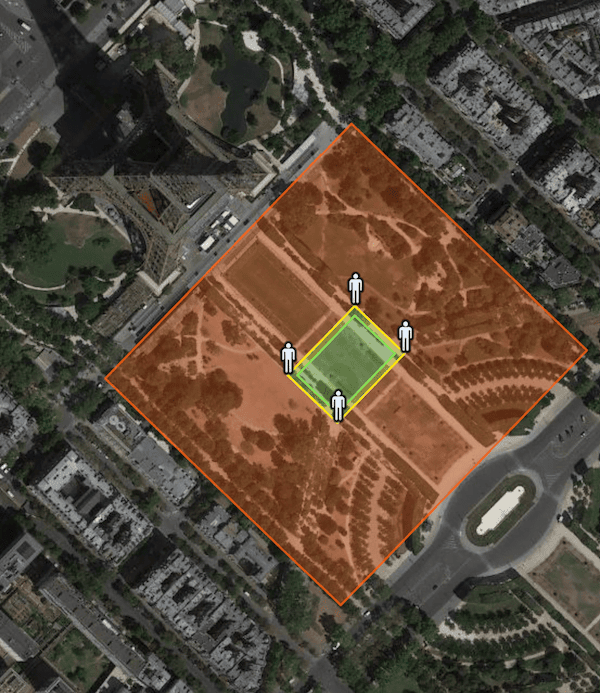
Here is an example of a setup on the Champs de Mars in Paris.