

In short, where things get really lively (and a little coffee spilled on the table)
- There methodical planning The reverse planning method avoids unforeseen events that always arise when you think everything is going smoothly, forget improvisation, logistics dance better with a well-defined checklist.
- There understanding of objectives and human relays is essential, without an engaged public or team, it spins its wheels, the key word is to choose and listen, not to program in automatic mode.
- There agile management of unforeseen events (and the budget that's sticking out) is learned on the job, digital helps but it's the human element that saves the day, every detail counts, especially after the show.
The energy sometimes overflows even before a microphone is switched on, while appointments are scheduled, and the large room waits, empty, to be filled. You've surely already experienced this mounting pressure, this shortness of breath, faced with hundreds of logistical decisions unfolding in a chaotic ballet, where no one truly believes in the magic of improvisation. With a light drone show, You'll be able to please your guests!
The budget taunts you, between martial rigor and dreams of grandeur with the flavor of chocolate mousse, logistics clings as best it can to white Excel sheets, and the tent rises, silent witness to a desire for impossible perfection. You know that every detail counts, every minute flies..
Are you looking for a event idea The events industry operates on a knife's edge; it's a constant murmur, almost a call. Between your audience and the project, there is always a tension that intrigues, sometimes exhausts, often galvanizes. Forget about ready-made models, The truth still throbs in this room, which buzzes and grows impatient..
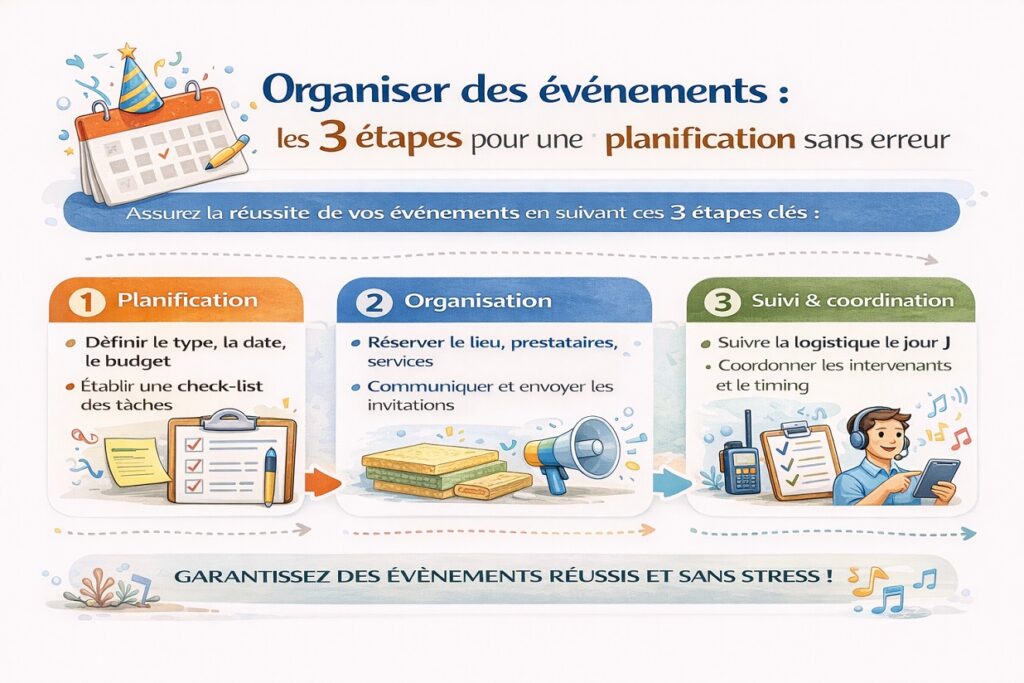
Understanding the expectations and objectives of an event
First and foremost, one question must be asked.: what are you really aiming for? If the answer eludes you, go back to basics, ask around, try to understand.
Defining the type and purpose of the event
A clear vision is always invaluable in this ever-changing world, where uncertainty is the norm. You've surely realized, after countless meetings, that everything begins with identifying your target audience and making an uncompromising choice of venue. Nothing is simple. A project manager sometimes gets caught between management's wishes and logistical needs, with each department imposing its own unique approach and pace.
Thus, success is forged through the precise definition of the goal; you feel it, everything else flows from there, and communication emerges all the sharper, more effective. You might be tempted to simplify everything, but beware, that path leads nowhere.
The selection of key stakeholders and participants
Your team is your anchor and your rudder.. You must choose, arbitrate, and invite, without sacrificing the diversity of voices; this is where conflicts arise, but also where solutions are found. Forget the compliant service provider; instead, look for the one who challenges and proposes solutions, even when it irritates your logistics manager. Absolutely, performance depends on the person who can hold their ground, provide direction, and set the course. On the other hand, poor communication between stakeholders, and the fear of failure, is never far away. Avoid including the public, VIPs, or anyone else; forget this strategy, it never works.
The formalization of budget and resource needs
You establish the budget by engaging in this slightly uncomfortable internal dialogue: where does the money go, to whom, and why? Anticipation saves more than one organizer. Distinguishing between venue rental and entertainment costs, and anticipating unforeseen circumstances, are skills acquired slowly, often through trial and error. Clarify, outline, and break down your plans, without giving in to the idea that everything will always work out in the end. However, you must absolutely avoid naivety when faced with a blank page; rigor cannot be decreed, it must be cultivated daily. You'll see, the budget spreadsheet will become your best ally.
| Event type | Main expenditure item | Key beneficiaries | Example budget |
|---|---|---|---|
| Professional event | Room rental, catering, communication | Employees, managers, partners | 5 000 , 15 000 € |
| Community event | Equipment, animation, local communication | Members, volunteers | 500 , 3 000 € |
| Trade fair/exhibition | Stands, promotion, logistics | Participants, visitors, exhibitors | 15 000 , 80 000 € |
In short, without a financial plan grounded in reality, every project risks going off track. Never lose sight of the close relationship between resources and ambition. It seems so obvious in theory, so slippery in practice.
Methodical planning and logistics management
Even the most modest events require discipline, an almost scientific process, far removed from the romantic chaos that some imagine.
Reverse planning and step-by-step checklist
No one is unaware of the urgency of reverse planning.. You see, every milestone, every deadline has its purpose; the slightest negligence will be paid for dearly on the day. A checklist, basic in appearance, often proves to be a lifesaver. You cross off the boxes, sometimes with a trembling hand.. The event's legend is built on the absence of improvisation, not the other way around. Therefore, always remember to anchor your priorities in a clear calendar and avoid confusion over deadlines.
| Stage | Example of a delay | Recommended actions |
|---|---|---|
| Project launch | D-90 | Scoping meeting, budget validation, role assignments |
| Venue and partner selection | 80 to 60 days before departure | Visits, quotes, reservations |
| Promotions and invitations | 45 days to 15 days before departure | Creating materials, sending invitations, follow-ups |
| D-Day | J | Reception, technical management, program monitoring |
Here you have the structure that saves. Nothing glamorous, but incredibly effective..
Managing logistics and unforeseen events: how to organize with agility
You've dealt with the before, now you have to survive the after. On the ground, the plan meets reality and sometimes gives way. A technical glitch, a supplier disappearing, unpredictable weather—you know the drill. You have to be flexible, not reckless. In fact, logistics is like an obstacle course marathon, where listening and responsiveness are essential. Having a backup plan, designating a relay point for emergencies – all of this builds your reputation..
Now, this demand for agility is the key to success in the industry. You can feel the difference between those who are overwhelmed by the unexpected and those who embrace and master it. In short, attention to detail is paramount, digital tools provide reassurance, but ultimately, the human element makes the decisions.
Event success and post-event optimization
A page has turned, the tumult is subsiding, the heart continues to beat.
Measuring results and analyzing feedback
You can't ignore the aftermath; your participants remember it, and so does your team. A short survey, a frank debriefing, often sheds more light than a thirty-page report. Analyzing the raw figures protects you from illusions.. Budget adherence, attendance rates, perceived engagement—each indicator gives meaning to the past event. However, keep in mind that even more important than the numbers is finding, in the overall feeling, a trace of what you attempted. A good debrief is as much about listening as it is about reading.. Intuition plays its part in this suspended moment..
Post-event promotion and communication
Publish, share, show, dare to document what happened, and what, perhaps, escaped the camera. The story of your event, this small narrative, gives permanence to an ephemeral experience. Giving thanks, sharing, continuing the conversation – all of this cements the collective memory of the adventure.. A well-designed portfolio is worth more than a long, soulless summary. It puts your project in the spotlight naturally, without forcing it or cheating. As a result, the cycle closes naturally: the audience returns or recommends, carried by the memory you've nurtured after the event.
The use of useful tools and resources within the organization
Technology evolves, and so do you.. An interactive whiteboard, a management app, registration software—all of these streamline communication, distribute pressure, and alleviate emergencies. You might be testing Trello or other tools; simplicity is never superfluous in these situations. Remember, however, that no machine can replace collective intelligence, the camaraderie on the ground, the knowing wink at a critical moment. Now, digital and lived experience coexist; you choose the right balance to guarantee both efficiency and humanity. Digital invitations are becoming widespread, as is survey-based management.. But nothing compares to the shared passion around the cockpit table..
Organize events with Allumee
With Allumee, Event organization takes on a whole new dimension. The line between technical innovation and scenographic boldness blurs, offering unforgettable experiences. In particular, the light drone show This perfectly embodies the fusion of technical and aesthetic elements: an animation that captures everyone's attention. These shows, which illuminate the sky with a thousand synchronized colors and shapes, become memorable moments for guests and a true asset for the company.
The strength of’Allumee Allumee's strength lies in its ability to inject creativity into every aspect of the event, while ensuring the necessary logistical robustness. Whether for internal meetings or public events, Allumee knows how to surprise its audience while respecting contemporary principles of efficiency and simplicity. With Allumee, every event becomes a unique moment, combining modernity, visual impact, and organizational fluidity.
Learn more
What are the steps involved in organizing an event?
Planning an event is a team sport, not a solo endeavor. Objectives, team, mission, budget, deadlines, partners, logistics—everything unfolds before you. It's a mix of frank meetings, positive feedback, and sometimes planning crises. Nothing is linear. This challenge helps you develop your skills at every turn.
What do you call a person who organizes events?
In the open-plan office, there's a murmur: "the conductor," event project manager, event organizer, mission leader. This colleague is also called a project manager, company representative, or team facilitator. Their toolkit: organization, feedback, team spirit, stress management, and a well-balanced sense of humor.
What are the 5 constituent elements of an event?
So, imagine a project: connection, collaboration, communication, creation, closure. Five key areas for successfully tackling this collective challenge within a company, boosting team spirit, meeting the deadline, and aiming for success. You do it, you adjust, you start again… Rapid skills development. The secret? Good feedback and lots and lots of enthusiasm.
How much does an event planner earn?
Let's talk about the taboo subject: the payslip. Event organizer: depending on experience, responsibilities, and profile, this role offers a gross salary between €1,500 and €3,000. There's no magic formula, but rather skills development, on-the-job training, and honest feedback. No fluff, just the reality of the job and the company.